
In sub-Saharan Africa, more than 800 million people do not have access to a traditional bank account. Yet they pay, receive, and save every day thanks to Mobile Money. For any entrepreneur who wants to sell online on the continent, ignoring this reality means cutting yourself off from the majority of your potential customers. This article explains everything you need to know about Mobile Money e-commerce in Africa and how to successfully integrate Mobile Money into your website.
The rapid rise of Mobile Money in Africa: key figures
Sub-Saharan Africa is today the region of the world where Mobile Money is most developed. According to the GSMA 2024 report, the region accounts for more than 60% of active Mobile Money accounts worldwide, representing approximately 835 million registered accounts.
Some statistics that illustrate this financial revolution:
- More than $1 billion in Mobile Money transactions are carried out every day in Africa.
- In Kenya, M-Pesa represents more than 50% of GDP in annual transaction volume.
- In Côte d'Ivoire, Senegal, and Cameroon, the Mobile Money penetration rate exceeds 70% of the adult population.
- The Mobile Money market in Africa is expected to reach $200 billion in transactions by 2027 (GSMA Intelligence).
- In West Africa, Wave has gained more than 10 million users in Senegal and Côte d'Ivoire in less than 5 years.
These figures are not anecdotal: they define the purchasing behavior of your future customers. An African e-merchant who does not accept Mobile Money is literally leaving money on the table.
Why Mobile Money is essential for African e-commerce
As we explain in our complete guide to e-commerce in Africa, the main barrier to online shopping on the continent is not a lack of consumer interest, but rather the absence of suitable payment methods. Mobile Money directly addresses this problem.
A still-low banking rate
Only 23% of adults in sub-Saharan Africa hold a formal bank account (World Bank, 2023). Accepting only Visa or Mastercard cards means excluding more than three-quarters of your target market. Mobile Money is the de facto bank account for the majority of Africans.
Massive mobile adoption
In Africa, more than 80% of internet connections are made via smartphone. Consumers are used to managing their money from their phone. Integrating Mobile Money into your online store means offering a native and familiar payment experience.
Reducing cart abandonment
Studies show that the cart abandonment rate drops significantly when Mobile Money is offered as a payment option. Customers do not need to enter a card number, remember a CVV code, or go through a bank. A simple USSD code or push notification is enough.
The main Mobile Money solutions in Africa
Here is an overview of the essential solutions for your e-commerce payment strategy:
MTN Mobile Money (MoMo)
Present in 17 African countries including Cameroon, Ghana, Côte d'Ivoire, Uganda, and Rwanda, MTN MoMo is one of the most powerful players on the continent. With more than 290 million registered users, it is often the first choice for e-merchants targeting Central and West Africa. MTN offers a well-documented REST API (MTN MoMo API) enabling payments, refunds, and transfers to be initiated directly from your platform.
Orange Money
Orange Money is deployed in 17 countries across Africa and the Middle East, with a strong presence in Africa: Senegal, Mali, Côte d'Ivoire, Cameroon, Madagascar. Orange Money also offers a merchant API (Orange Money API) that allows developers to integrate online payments securely. The solution is particularly popular among SMEs and startups.
Wave
Wave is the solution that disrupted the market by offering near-zero transaction fees (1% capped). Available in Senegal, Côte d'Ivoire, Mali, Burkina Faso, and Uganda, Wave wins users over with its simplicity and intuitive mobile app. For merchants, Wave Business offers a payment API and instant payment links, ideal for small online stores.
Airtel Money
Airtel Money covers 14 African countries primarily in East and Central Africa (Kenya, Tanzania, Zambia, DRC, Rwanda). It is an essential player if your store targets these markets. Airtel Money offers a merchant API and integrates easily via payment aggregators.
How to integrate Mobile Money into your e-commerce site
There are several approaches to successfully integrating Mobile Money into your website, depending on your technical level and budget.
Option 1: Direct integration via API
Each operator (MTN, Orange, Airtel) offers a documented REST API. This approach offers the most flexibility but requires development skills. The key steps are:
- Create a merchant account with the operator (MTN MoMo Developer Portal, Orange Developer).
- Obtain your API keys (API Key, API Secret, Subscription Key).
- Test in a sandbox environment before going live.
- Implement the payment endpoints (Request to Pay, Disbursement, Remittance).
- Handle callbacks (webhooks) to confirm transactions in real time.
Option 2: Using a payment aggregator
Payment aggregators such as CinetPay, Paystack, Flutterwave, Notchpay, or PayDunya allow you to integrate multiple Mobile Money solutions simultaneously through a single API. This is the recommended solution for most e-merchants as it considerably simplifies payment development and management.
Advantages of aggregators:
- A single integration for MTN MoMo, Orange Money, Wave, Airtel Money, and sometimes bank cards.
- Unified dashboard to track all your transactions.
- Dedicated technical support and documentation in English.
- Regulatory compliance managed by the aggregator.
Option 3: Plugins for WooCommerce, Shopify, and PrestaShop
If your store runs on WooCommerce, Shopify, or PrestaShop, dedicated plugins exist to simplify integration:
- WooCommerce: CinetPay for WooCommerce, Flutterwave WooCommerce, Notchpay WooCommerce Gateway plugins.
- Shopify: Flutterwave Shopify App, Paystack Shopify Plugin.
- PrestaShop: CinetPay and PayDunya modules available on the official marketplace.
Installation takes just a few clicks, without writing a single line of code. This is the ideal solution for non-technical entrepreneurs.
The benefits of Mobile Money for merchants and customers
For e-commerce merchants
- Access to a wider market: reach unbanked customers who represent the majority of the population.
- Instant payments: funds are available in real time, with no bank clearing delay.
- Reduced non-payment risk: payment is confirmed before dispatch, eliminating the risk of bounced checks.
- Full traceability: every transaction is recorded and viewable from your dashboard.
- Lower costs: Mobile Money transaction fees are generally lower than those of international bank cards.
For customers
- Ease of use: paying with your phone number is as simple as sending an SMS.
- Enhanced security: every transaction is protected by a personal PIN code, without exposing sensitive banking data.
- Universal accessibility: works even without a smartphone or internet connection via USSD (*126#, *144#, etc.).
- Instant confirmation: the customer immediately receives an SMS payment confirmation.
Mobile Money and online payment in Cameroon: a concrete use case
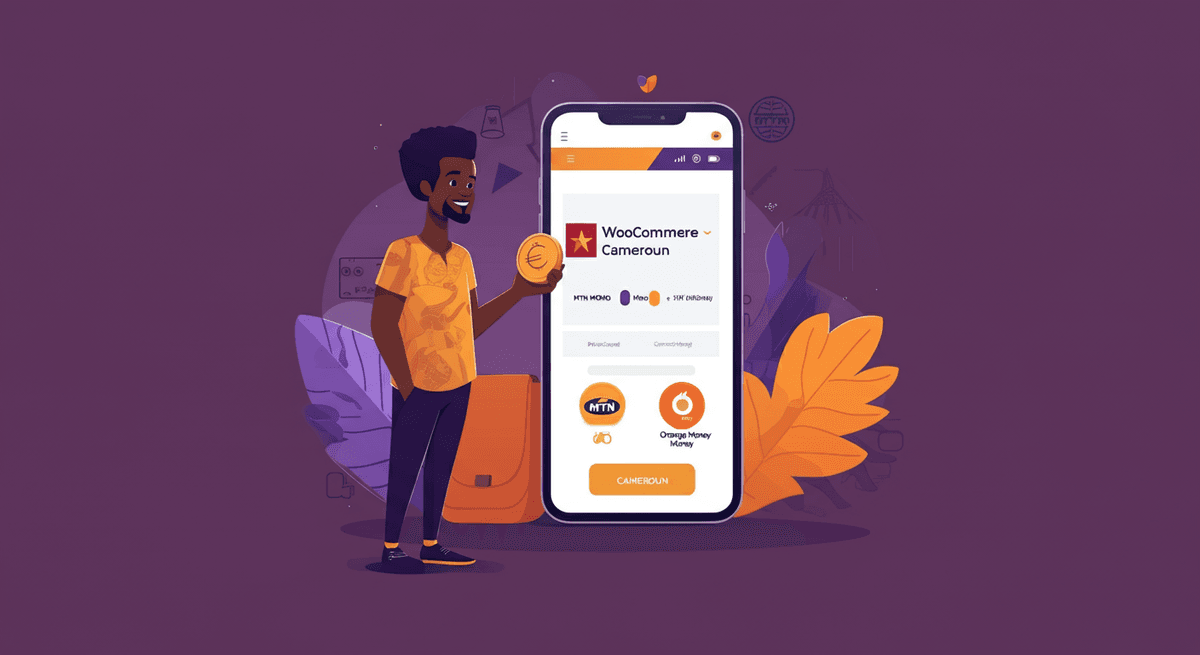
Cameroon is a particularly telling example. With MTN MoMo and Orange Money sharing the market, more than 12 million Cameroonians use Mobile Money on a daily basis. To go further on local specifics, see our dedicated article on online payment in Cameroon, which details the solutions, fees, and best practices for Cameroonian merchants.
Platforms such as Jumia Cameroon, Afrimarket, and local WooCommerce stores have seen their conversion rates increase by 30 to 50% after integrating Mobile Money. The lesson is clear: adapting your payment funnel to the local context is a direct growth lever.
Outlook 2026–2027: towards an even more integrated Mobile Money
The coming years look decisive for Mobile Money in Africa. Here are the trends to watch:
Interoperability between operators
Several African countries (Ghana, Tanzania, Rwanda) have already made interoperability between Mobile Money operators mandatory. By 2027, this trend is expected to extend across all of West and Central Africa, further simplifying cross-border payments for e-merchants.
The rise of social commerce and m-commerce
WhatsApp Business, TikTok Shop, and Instagram Shopping are progressively integrating Mobile Money payment solutions. By 2026, selling directly from a WhatsApp conversation with an MTN MoMo or Orange Money payment will be the norm for millions of small African merchants.
Mobile credit and BNPL (Buy Now Pay Later)
Solutions such as M-Shwari (Kenya), Orange Money Crédit, and MTN Qwikloan already allow users to obtain instant micro-loans via their Mobile Money account. African BNPL, backed by Mobile Money, is expected to explode between 2025 and 2027, opening new opportunities for e-merchants looking to increase their average basket size.
Integration with stablecoins and CBDCs
Several African central banks (Nigeria with the eNaira, Ghana with the eCedi) are developing central bank digital currencies (CBDCs) that will build on existing Mobile Money infrastructure. This convergence could radically transform the African digital payments landscape by 2027.
Conclusion: Mobile Money, an essential pillar of your African e-commerce strategy
Integrating Mobile Money into your online store is no longer optional: it is a strategic necessity for any e-merchant targeting the African market. Whether you go through the direct API of MTN MoMo, Orange Money, Wave, or an aggregator like CinetPay or Flutterwave, the key is to act now.
At BEONWEB, we support African entrepreneurs in creating and optimizing their online stores, with particular expertise in local payment solutions. Contact us for a free audit of your payment funnel and discover how to multiply your conversions with Mobile Money.
Editorial desk & expertise
Our team combines SEO strategists, web developers, designers and digital marketers — all working daily on real client projects across Cameroon and Francophone Africa.