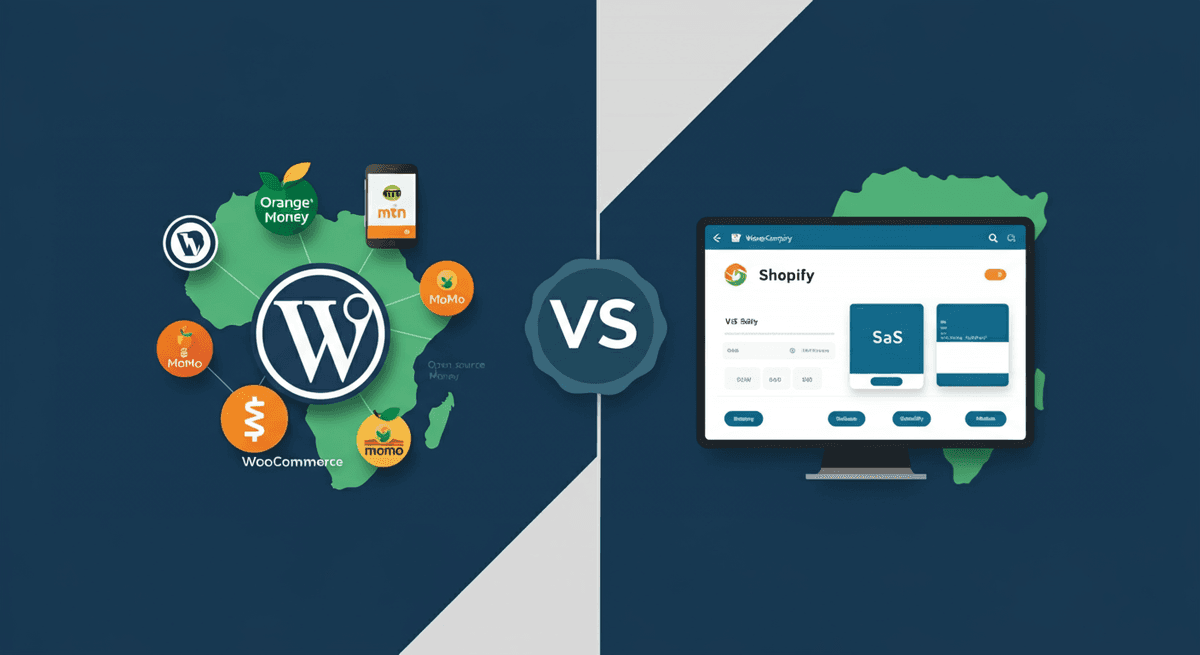
The e-commerce market in Africa is experiencing explosive growth. With millions of new internet users every year and rapid mobile adoption, creating an online store has become a strategic priority for many African entrepreneurs. But faced with the overwhelming number of platforms available, two names consistently come up: WooCommerce and Shopify. Which one should you choose for your market? This article offers a comprehensive comparison, designed specifically for African realities.
To go further, check out our complete guide on e-commerce in Africa, our pillar page covering all the strategies to succeed with your online store on the continent.
Overview of the two platforms
WooCommerce: the open-source freedom
WooCommerce is a free e-commerce extension for WordPress, the world's most widely used CMS. Launched in 2011 by WooThemes (acquired by Automattic in 2015), it now powers more than 28% of online stores worldwide. Its open-source model means you download, install, and host the solution yourself — giving you full control over your store, your data, and your costs.
WooCommerce is particularly popular in French-speaking Africa, notably in Cameroon, Côte d'Ivoire, Senegal, and Morocco, where WordPress developers are plentiful and local hosting costs are affordable.
Shopify: the all-in-one solution
Shopify is a SaaS (Software as a Service) platform founded in 2006 in Canada. Unlike WooCommerce, everything is hosted and managed by Shopify: you pay a monthly subscription and benefit from a turnkey infrastructure. With more than 4 million merchants worldwide, Shopify is recognized for its ease of use, reliability, and rich app ecosystem.
In Africa, Shopify is gaining ground, particularly in South Africa, Nigeria, and Kenya, driven by a dynamic English-speaking community and growing integration with local payment solutions.
Detailed comparison: WooCommerce vs Shopify for the African market
1. Costs and budget
WooCommerce is free to install, but costs add up: hosting ($5–$30/month), domain name (~$10/year), premium theme ($50–$200), paid extensions (payment gateways, SEO, security). Overall, a starting budget of $200–$500 is realistic for a functional store.
Shopify offers three main plans: Basic ($29/month), Shopify ($79/month), and Advanced ($299/month). Add to that transaction fees (0.5–2% if you don't use Shopify Payments, which is unavailable in most African countries) and third-party apps. For an African entrepreneur, transaction fees can represent a significant cost over the long term.
2. Ease of use
Shopify clearly wins this round. Its intuitive interface allows a non-technical user to launch a store in just a few hours. Product, order, and delivery management is centralized and straightforward.
WooCommerce requires more technical skills: installing WordPress, configuring extensions, managing hosting, handling security updates. If you don't have a developer or technical service provider, the learning curve can be daunting.
3. SEO (Search Engine Optimization)
WooCommerce, paired with WordPress and plugins like Yoast SEO or Rank Math, offers exceptional SEO control: customizable meta tags, clean URLs, structured data, optimizable speed, integrated blog. It is the ideal tool for an ambitious content strategy targeting keywords like "WooCommerce vs Shopify Africa" or "best e-commerce platform Africa".
Shopify also offers good basic SEO features (title tags, meta descriptions, automatic sitemaps), but remains less flexible than WooCommerce for advanced configurations. The URL structure is sometimes rigid and certain technical optimizations require paid apps.
4. Local payments in Africa
This is the most decisive criterion for the African market. The dominant payment methods on the continent are Mobile Money (Orange Money, MTN MoMo, M-Pesa, Wave), local bank transfers, and cash on delivery.
WooCommerce has a very rich extension ecosystem for African payments: CinetPay, Kkiapay, PayDunya, Flutterwave, Paystack, DPO Group, and many others. These integrations are often developed by local players who understand the specificities of the market.
Shopify also supports Flutterwave, Paystack, and DPO Group via its App Store, but the absence of Shopify Payments in most African countries means additional transaction fees (0.5–2%) on every sale. On high volumes, this can represent thousands of dollars in annual fees.
5. Support and community
Shopify offers 24/7 customer support via chat, email, and phone, in multiple languages. This is a considerable advantage for entrepreneurs who don't have a technical team.
WooCommerce relies on a global open-source community and abundant documentation. In Africa, the WordPress community is active in many countries (WordCamp Abidjan, Dakar, Nairobi, Lagos). However, official support is limited — you depend on your hosting provider, your developer, or community forums.
Comparison table: WooCommerce vs Shopify in Africa
Here is a summary of the main comparison criteria between the two platforms in the African context:
Criterion | WooCommerce | Shopify
- Starting cost: ~$200–500 (one-time) | $29/month minimum
- Transaction fees: 0% (depending on gateway) | 0.5–2% (Shopify Payments unavailable in Africa)
- Ease of use: Technical (3/5) | Very intuitive (5/5)
- Advanced SEO: Excellent (5/5) | Good (4/5)
- Mobile Money payments: Very rich (5/5) | Limited (3/5)
- Customization: Total (5/5) | Limited (3/5)
- Official support: Community (2/5) | 24/7 (5/5)
- Hosting: Your responsibility | Included in subscription
- Scalability: Depends on hosting provider (4/5) | Automatic (5/5)
- Data ownership: Total | Shopify dependency
Pros and cons for the African market
WooCommerce in Africa: the advantages
- No transaction fees: you keep 100% of your revenue (excluding the payment gateway's own fees).
- Very comprehensive Mobile Money integrations: CinetPay, Orange Money, MTN MoMo, Wave, Kkiapay, PayDunya, etc.
- World-class SEO thanks to the WordPress ecosystem.
- Full ownership of your data and your store.
- Unlimited customization: adapt your store to local cultural and commercial specificities.
- Active WordPress community in many African countries.
WooCommerce in Africa: the disadvantages
- Requires technical skills or a trusted service provider.
- Maintenance and security are your responsibility (updates, backups, SSL).
- Performance depends on the quality of the chosen hosting.
- Longer setup time than a SaaS solution.
Shopify in Africa: the advantages
- Ultra-fast launch: online store up and running in a few hours, with no technical skills required.
- Robust and scalable infrastructure: ideal for traffic spikes (promotions, sales).
- 24/7 support in multiple languages.
- Rich App Store with thousands of applications to extend functionality.
- Native integration with social networks (Instagram Shopping, Facebook Shop, TikTok).
Shopify in Africa: the disadvantages
- Transaction fees of 0.5–2% on every sale (Shopify Payments not available in sub-Saharan Africa).
- Recurring monthly cost, even during periods of low activity.
- Less flexibility for specific local payment integrations.
- Platform dependency: if Shopify changes its terms or shuts down, your store is impacted.
- Limited customization compared to an open-source solution.
Recommended use cases: WooCommerce for whom? Shopify for whom?
Choose WooCommerce if…
- You already have a WordPress site or want to combine a blog and an online store.
- You are targeting an ambitious SEO strategy with regular editorial content.
- You need Mobile Money integrations specific to your country (Orange Money, MTN MoMo, Wave, CinetPay…).
- You want to control your costs over the long term and avoid transaction fees.
- You have access to a trusted local developer or web agency.
- You manage a complex product catalog with advanced customization needs.
Choose Shopify if…
- You want to launch your store quickly, without technical skills.
- You are primarily targeting English-speaking markets (South Africa, Nigeria, Kenya) where Shopify is well established.
- You are planning rapid growth and need a scalable infrastructure without technical management.
- You sell primarily through social networks and want native integration with Instagram, Facebook, or TikTok.
- You have a stable monthly budget and prefer to delegate technical maintenance.
BEONWEB's recommendation
After supporting many African entrepreneurs in creating and optimizing their online stores, our recommendation is clear: WooCommerce is the best e-commerce platform for the majority of African markets.
Here's why: in French-speaking Africa, Mobile Money is king. Orange Money, MTN MoMo, Wave, and CinetPay often account for more than 70% of online transactions. WooCommerce offers the best integrations for these solutions, with no additional transaction fees. Paired with a solid SEO strategy on WordPress, it is the most powerful tool for building a lasting and profitable digital presence.
That said, Shopify remains an excellent choice for entrepreneurs who want to get started quickly, without a technical team, and who operate in English-speaking or international markets. If your priority is speed of launch and simplicity of management, Shopify may be the right option.
In summary: choose WooCommerce for power, flexibility, and long-term savings. Choose Shopify for speed and simplicity. In either case, what matters is choosing the platform that matches your resources, your goals, and your target market.
Conclusion
The WooCommerce vs Shopify debate in Africa has no universal answer. Everything depends on your context: your country, your budget, your technical skills, your target payment methods, and your SEO ambitions. This comparison gives you the keys to make an informed choice.
At BEONWEB, we support African entrepreneurs in creating high-performing online stores, optimized for SEO and adapted to the realities of the local market. Whether you choose WooCommerce or Shopify, our team is here to guide you every step of the way.
Discover our complete guide on e-commerce in Africa to go even further in your digital strategy.
Editorial desk & expertise
Our team combines SEO strategists, web developers, designers and digital marketers — all working daily on real client projects across Cameroon and Francophone Africa.