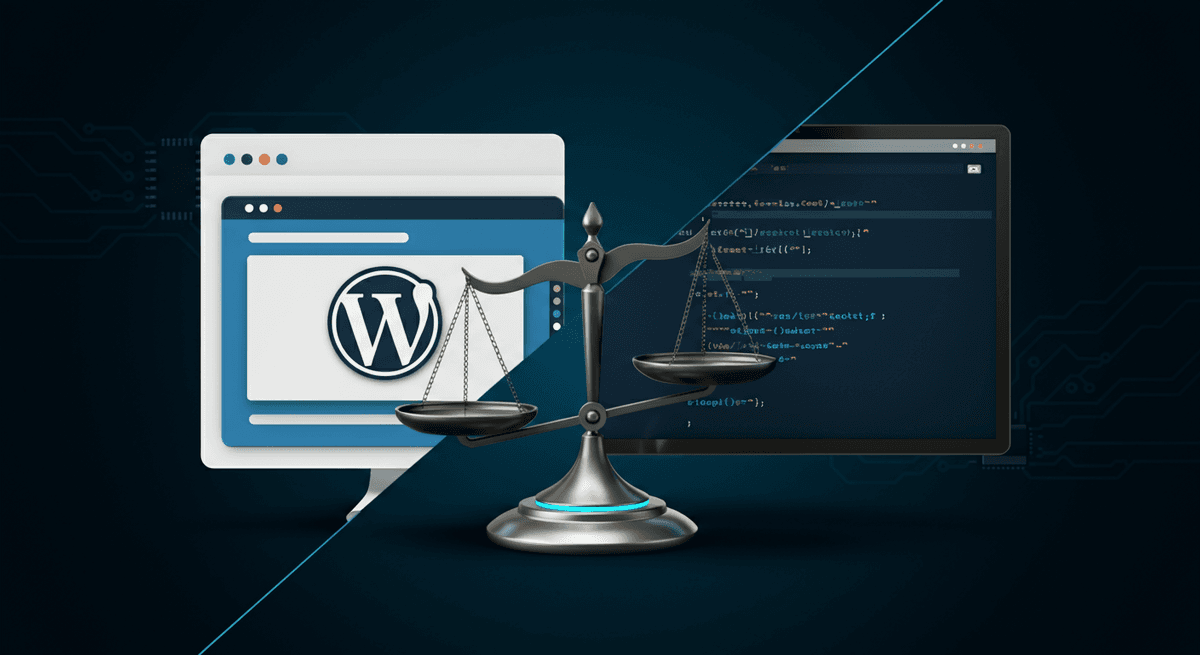
In 2026, the question comes up systematically in every web project meeting: should you go with WordPress or invest in custom development? This strategic choice directly impacts your costs, organic search rankings, scalability, and user experience. In this article, we offer a comprehensive comparison, specifically designed for African businesses and SMEs undergoing digital transformation.
1. Understanding Both Approaches
WordPress: The World's Most Used CMS
WordPress powers over 43% of all websites worldwide. It is an open-source, free content management system (CMS) surrounded by a massive ecosystem: over 60,000 plugins, thousands of themes, and a global developer community. It allows you to launch a professional website in just a few days, without necessarily mastering code.
Custom Development: Total Freedom, Targeted Investment
A custom website is built from scratch (or nearly so) by a development team using modern technologies like React, Next.js, Vue.js, Laravel, or Node.js. Every feature is designed and built to meet your business's exact needs. No unnecessary code, no theme constraints, no dependency on third-party plugins.
2. Detailed Comparison: 8 Essential Criteria
2.1 Development Cost and Initial Budget
WordPress is the most financially accessible option to get started. A professional WordPress site can be delivered for between 500,000 and 2,000,000 FCFA depending on complexity. Custom development typically starts at around 3,000,000 FCFA and can reach tens of millions for complex platforms.
However, the total cost of ownership (TCO) over 3 to 5 years can reverse: premium plugin licenses, updates, security patches, and recurring technical interventions on WordPress can exceed the initial investment of a well-architected custom site.
2.2 Time to Launch
WordPress excels in deployment speed. A showcase website can be live in 1 to 3 weeks. A custom site requires an average of 6 to 16 weeks depending on feature complexity. If your priority is speed to market, WordPress clearly has the advantage.
2.3 Performance and Loading Speed
Performance has been a major SEO criterion since Google introduced Core Web Vitals. An unoptimized WordPress site can be slow due to heavy themes, poorly coded plugins, and excessive database queries. With proper configuration (caching, CDN, image optimization), it can achieve excellent scores.
A custom site built with modern frameworks like Next.js natively benefits from server-side rendering (SSR), lazy loading, and an optimized architecture. It structurally achieves better performance, resulting in better Google rankings and a superior user experience.
2.4 SEO and Organic Search
WordPress has powerful SEO tools like Yoast SEO or Rank Math, which simplify the optimization of meta tags, XML sitemaps, and structured data. This is an undeniable advantage for marketing teams without technical skills.
Custom development offers total control over technical SEO architecture: clean URLs, canonical tags, custom Schema.org structured data, fine-tuned HTML rendering, advanced redirect management. For high-volume page sites or advanced SEO strategies, custom is often superior.
2.5 Security
WordPress is the number one target for cyberattacks due to its popularity. Outdated plugins, poorly maintained themes, and weak passwords are the main entry points. Solutions exist (Wordfence, automatic updates, secure hosting), but they require constant vigilance.
A custom site has a much smaller attack surface: no vulnerable third-party plugins, no CMS known to hackers, proprietary architecture. Security is built in from the design phase. This is a decisive advantage for companies handling sensitive data (e-commerce, fintech, healthcare).
2.6 Scalability and Growth Potential
WordPress can handle large sites but reaches its limits with very high traffic volumes or highly specific features. Adding complex functionality often requires plugins that bloat the system or custom developments that work around the native architecture.
Custom development is designed to scale. Microservices architecture, RESTful APIs, and optimized databases allow horizontal scaling without limits. It is the natural choice for hypergrowth startups, SaaS platforms, and marketplaces.
2.7 Content Management Ease
This is WordPress's home turf. Its admin interface is intuitive and accessible to non-technical users. Publishing an article, editing a page, or adding a product requires no development skills. This is a major asset for autonomous marketing teams.
Custom sites often integrate a headless CMS (Sanity, Strapi, Contentful) that provides a modern and flexible admin interface. The learning curve may be slightly higher, but the experience is often better tailored to the company's specific needs.
2.8 Long-Term Maintenance and Support
WordPress maintenance is ongoing: core, theme, and plugin updates, regular backups, security monitoring. A monthly maintenance contract is strongly recommended. For a custom site, maintenance is less frequent but requires developers who master the technical stack used.
3. Concrete Use Cases for African Businesses
When to Choose WordPress?
WordPress is the ideal choice in the following situations:
- Showcase website for an SME, firm, or association with a limited budget
- Corporate blog or online media requiring regular content publishing
- Mid-size e-commerce store with WooCommerce (fewer than 5,000 products)
- Project requiring fast go-live (less than 4 weeks)
- Internal team wanting to manage content autonomously without a developer
When to Choose Custom Development?
Custom development is the right choice in these contexts:
- SaaS platform, marketplace, or web application with complex business features
- Hypergrowth startup requiring a scalable architecture from the start
- Fintech, healthtech, or edtech company with high security and compliance requirements
- Integration with existing systems (ERP, CRM, mobile banking APIs like Orange Money or Wave)
- Need for maximum performance and a differentiating user experience
4. The African Context: Specific Factors to Consider
In West and Central Africa, several factors specifically influence this choice. Mobile connectivity is dominant: over 70% of internet users browse on smartphones, sometimes with limited connections. Mobile performance is therefore a non-negotiable criterion.
Local payment integrations (Orange Money, MTN Mobile Money, Wave, Moov Money) are often absent from standard WordPress plugins. Custom development allows these solutions to be integrated natively, offering a smooth payment experience tailored to the local market.
Multilingualism (French, English, local languages) is also a key issue. WordPress handles multilingual content well with plugins like WPML or Polylang, but a custom site can offer more refined and performant management of multilingual content.
5. Summary Table: WordPress vs Custom
Here is a summary of the strengths and weaknesses of each approach:
- Initial Cost — WordPress: âÅ“… Low | Custom: âÅ¡ ︠High
- Delivery Time — WordPress: âÅ“… Fast (1-3 wks) | Custom: âÅ¡ ︠Long (6-16 wks)
- Performance — WordPress: âÅ¡ ︠Variable | Custom: âÅ“… Optimal
- Security — WordPress: âÅ¡ ︠Plugin risks | Custom: âÅ“… Controlled
- Scalability — WordPress: âÅ¡ ︠Limited | Custom: âÅ“… Unlimited
- Content Management — WordPress: âÅ“… Intuitive | Custom: âÅ“… Flexible (headless CMS)
- Technical SEO — WordPress: âÅ“… Dedicated plugins | Custom: âÅ“… Full control
- Local Integrations (Mobile Money) — WordPress: âÅ¡ ︠Limited plugins | Custom: âÅ“… Native
6. The Hybrid Solution: The Best of Both Worlds
More and more African web agencies, including BEONWEB, are offering a hybrid approach: a custom front-end (Next.js, Nuxt.js) paired with a headless CMS like Sanity or Strapi. This architecture delivers the performance and flexibility of custom development, with the content management ease of a modern CMS.
This Jamstack or headless CMS approach is particularly suited to companies that want an ultra-performant, secure, and scalable website, while maintaining an admin interface accessible to their non-technical teams.
7. Our Final Recommendation
There is no universal answer to the WordPress vs custom question. The right choice depends on your budget, business objectives, internal technical capacity, and growth horizon. What is certain is that a poorly chosen website costs more in the long run than a well-considered initial investment.
At BEONWEB, we have been helping African businesses make this strategic choice for several years. Our approach: understand your real needs, analyze your market, and propose the most suitable solution — whether WordPress, custom, or hybrid. Contact us for a free audit of your web project.
Editorial desk & expertise
Our team combines SEO strategists, web developers, designers and digital marketers — all working daily on real client projects across Cameroon and Francophone Africa.